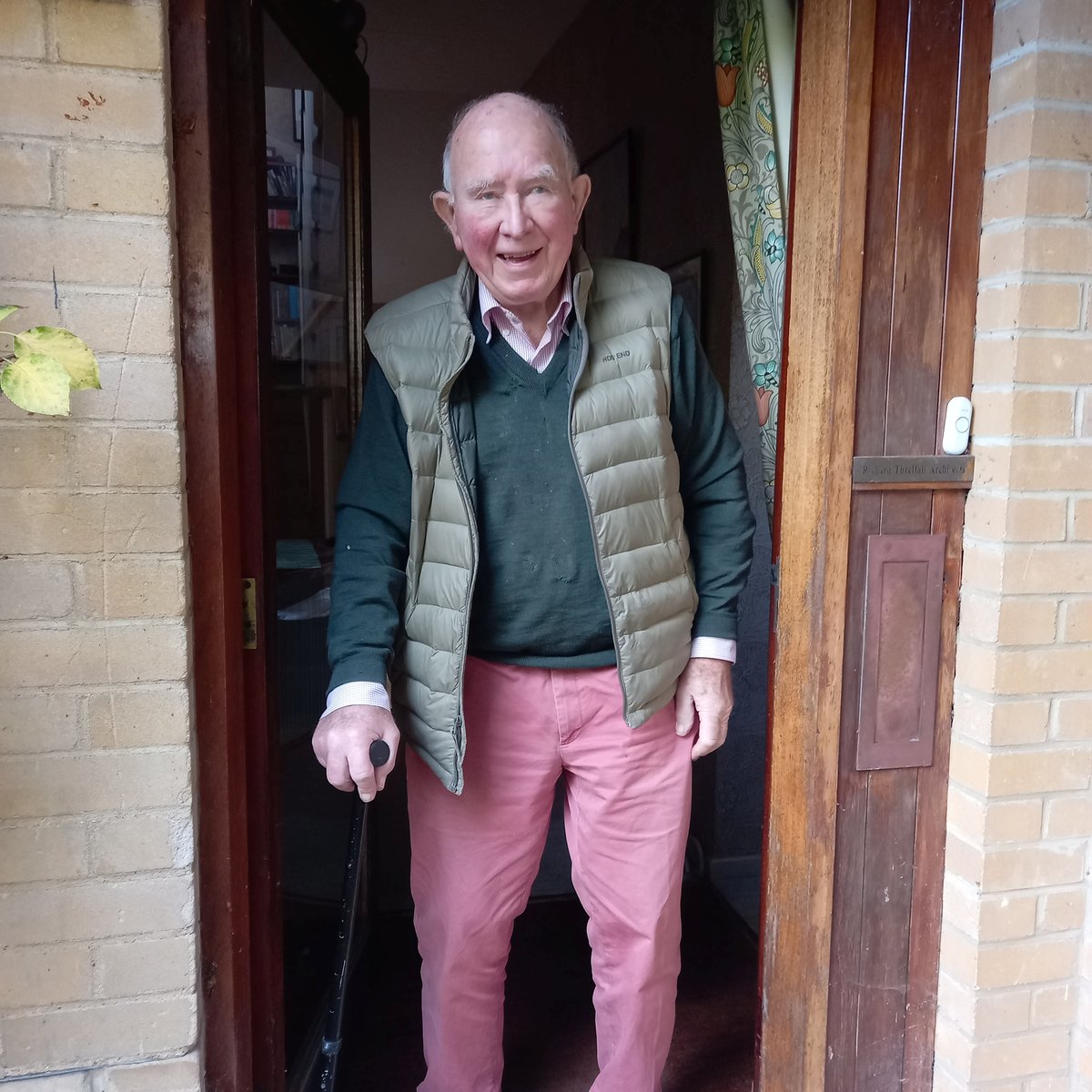
Interviewed by Peter Ruffles (PR) & Geoff Cordingley (GC)
Date: 15/11/2024
Transcribed by Geoff Cordingley (using Otter AI for initial transcript)
Hertford Oral History Group
Recording no: O2023.6
Subject: Richard Threlfall (RT)
Date: 15th November 2024
Venue: 18, Mangrove Road, Hertford
Interviewer: Peter Ruffles (PR) & Geoff Cordingley (GC)
Transcriber: Geoff Cordingley (using Otter AI for initial transcript)
Typed by: Geoff Cordingley
************** unclear recording
[discussion] untranscribed material
italics editor’s notes
PAR: Well, we, this afternoon, which is the afternoon on a Wednesday, the 15th of November. This is Geoff Cordingley and Peter Ruffles at the home of Rachel and Richard Threlfall, at the well-known address of 18, Mangrove Road. And we're going to talk to Richard about some of the many institutions, things generally, that he's been involved in for the last 50 years or so, presumably,
RT: Institutions in Hertford, yes.
PAR: In Har'ford, yes. So, we mentioned the address, particularly because this is such a lovely house, lovely spot. How did you come to be here?
RT: Because we were living just across the valley in Queens Road, and Dr Jeleens told me that the doctor who lived here at the time, was going to Australia, and we wanted more space, space for Paul to play football. And (laughing) we came and bought it more or less on the spot.
PAR: Yes. What a buy. So the pig farm below had gone, God, yeah.
RT: Well, Valley Close had happened, yes, yeah. The Queens Road house, at 57, Queens Road, which is a new semi, semi-detached house was built when, in the, well, in '65 or so. But then the original house, original house here, I say it's original, it was built early in the '50s, late '50s, and that was built as a, built under license was around at that time, which was only 1000 square feet,
PAR: Ah, yes.
RT: And it's now got extended as 2000 square feet.
PAR: But it's been a home and a business headquarters,
RT: Been a home and, and force of circumstances became, became an office, an architect's studio, yes.
PAR: So, where were you before you arrived in Har'ford, the pair of you?
RT: In Islington.
PAR: Oh!
RT: We'd, well, I was a student in London, and I met Rachel. Grandmother, introduced me to her at a village fete in Abbots Langley, (laughing) telling me to count the number of peas in the jar, or guess the number of peas in the jar. And grandmother who was a doyen of Abbot's Langley. We don't know whether it was by design, but by, not by accident, I don't think, because Rachel's parents had just bought a house in Abbots Langley. As, as a naval officer, he was on shore working in the Admiralty. They had this house and, well, I met her and was asked to join in, go to a tennis, a tennis, tennis lawn dance and, ah, well, we sort of never stopped, (laughing) ever since. Ah, that was, by measuring them in Abbots Langley, but it took me seven years to manage to let mother-in-law marry her.
Father-in-law had already told the vicar that he knew, he knew we were to get married fairly, fairly early on, but he unfortunately died of a brain, of a carcinoma. Yeah, when Rachel was coming, Rachel was coming back from a year in America. Mother-in-law or potential mother-in-law had sent her to America as a radiographer to get away from me but it didn't work.
GC: What year was that?
RT: Well? We got married in '62, ahm, so she must have gone in '58 I should think, '59.
PAR: So your three children were Har'ford born and bred?
RT: No. Sarah was, Sarah, we, when we, as, just after we got married, a few weeks after being married, we went to Australia for two years. I was having some time out from college and wanted a job overseas. And the job I got was to be a diocesan architect and the Diocese of Carpentaria, in, which is based on what, in those days was based in Thursday Island, on the top of the Torres Straits, which is the top of, the top of Australia, above Cape York.
PAR: And Sarah was born there was she?
RT: No, no, she wasn't. I disagreed with the bishop after a year, and we then moved around looking for work. Australia didn't have any work at the time, and we ended up, ended up in Sydney, and had a good year and a half in Sydney, where I worked in three offices, and we sailed on Sydney Harbour. But Rachel was a radiographer, and was a qualified radiographer, and had been for years, and that she went out, and she did when she went out to America, and her joy was that wherever she went, she could ring up Kodak, the representative locally, and he found her a job. And so she found jobs more or less easily in Sydney.
No, we came back after, after a couple of years, we came back, and I had to go back to college and finish off another year, and we had a flat in, ahm, near the Archway in Islington, and Sarah was well, conceived there, surprisingly. It was a surprise, actually. (Laughs) And she was born in UCH, which is where father trained as a dentist. That was coincidence again. In a cold, very cold November, cold November time. From the flat, we bought a house which we, which was full of dry rot and learned from it, and carried, Rachel moved in, into the XXXX of a three story house that was being taken apart, and we moved to Hertford in '72 because Rachel said she had enough, enough of Islington.
PAR: So the boys were born here.
RT: No, no. Paul was, sorry, Paul was born in Islington and baptised out in Chandler's Cross because mother-in-law moved from Tunbridge Wells. She went from King's Langley to, went from Abbots Langley to Tunbridge Wells for the captain's job, and the captain died on the, died, and she moved back to Hertfordshire and lived at, lived at Chandlers Cross and then Chipperfield. So. But Paul, Sarah was born, and then Paul was born, and we moved to Hertford, into, into, ahm, into Queens Road and, and Anthony was born there, literally born there in the house. It just took him an hour to arrive. (Laughing) The midwife was only in the house for an hour.
PAR: Ah, good times. Well, I think we're particularly interested in, I suppose, of all things, the Civic Society and its early times. Ahm, how did you become involved? Who was around at that time?
RT: Well, it was, it was David Kirby, who set that up, David Kirby, who had the inspiration and set it up. He just thought being a do-gooder, being a very busy person, had the, he always told the story of canoeing down the river from his, from his house, and seeing and decided, well, just working out Hertford needed, needed a civic society. In that time, in the '70s, it was the birth of civic societies and civic trust, and that was his intention. I know we had a, when, within I should think '70, I've been trying to work it out actually '72 or '73 we had a meeting in the Mercury, in the Mercury Building in Fore Street when it was there. And, and for, the civic society got formed, sort of put together by hook or by crook, and, ahm, it just grew out of that. And it was, it was pushed along by the, I don't quite know the connection between David and, and Alan Melville.
Well, Alan Melville was a, was a solicitor who had a, had a lovely sort of family group of houses in the Grove. And, ahm, where they, how they came to join up, I don't fully remember, but of course, we set in quite quickly with the disturbing, what was then planning law, or planning arrangements. In those days, it was a, with the new town developments had happened, and Hertford had, had a central area, which was known to be rather good and the county council had described it as a development area, and various town councillors who, I don't think Peter was one at the time, ah,
PAR: I absolve myself from that. I did come to the Mercury or to a very early meeting. It may have been, ahm, I thought it was the Corn Exchange, so it may have gone public.
RT: No, no, no, no! It hadn't gone public by then.
PAR: Yes.
RT: I should think, Reggie Hall was, was vicar at All Saints, and he was involved with it and helped put it together. I don't know what, what much he had to do with it, because, of course, he moved on early in the mid '70s.
PAR: So the setting up, aah, was David's brain child on a canoe coming in from Molewood.
RT: Yes,
PAR: But it wasn't because of that impending planning?
RT: No,
PAR: it was for its own sake.
RT: It was just for his own sake, I think, yes, yeah, and then, Alan was involved, or maybe Alan became involved. In the, in the major, as I was saying, the councillors decided the town needed to be developed, and, ahm, they wanted to sort of blast the whole of middle out, from Bull Plain across to Bircherley Green, across Bircherley Green, and wanted to just pull it all down and redevelop it. And various folks said, decided to save the heart, the heart of Hertford, which may have involved Alan at that time, or Alan helped to stir up and get, get listed building special status for Railway Street, and that, the whole of that area, which helped, helped to create a furore, and somebody pulled that into a, into a public inquiry. I don't, I don't know that, remember all the details that happened around that time.
I just know it was all very live and bright and we're all bushy tailed and young, young, well, young business people. And David was very full of enthuse, enthusiasm, but just kept stirring it along because, ahm, he also, that and ahm, stirring up the public inquiry, he got Richard Harris involved, who was living in, in Highfield Road.
PAR: Ah, and now, well move subsequently to Little, Little Berkhamsted, no Brickendon,
RT: Where he died […] yeah,
PAR: a year ago. Maybe, so were the early committee meetings, if we can call them that held at the Melvilles?
RT: No, they were held at, they were held at David's house, oh, in Molewood End. No regular, regular meetings there. No, I was thinking about that sort of sitting on the sofa in David's living room, arguing things out,
PAR: And would Alan Melville have been there?
RT: No, he wasn't there. He wasn't there. It just sort of happened. I was, have been trying to think out how Alan, or maybe it was just that David suggested whether he should become chairman, or Alan offered to become chairman. He was a fairly high-powered civil servant, and so he obviously was commuting to and from but I don't fully remember, I didn't really fully discover which department he managed.
PAR: It's of some interest to us, because the character of Har'ford Civic Society differs from, for example, Ware Society set up for the same kind of purpose, but with a different ethos. And I've wondered how, because Har'ford's benefited, particularly from having professional, cerebral people, not that Ware doesn't but,
RT: Yes,
PAR: But that seems to be the essential thing, the the prime movers were each of them, it seems, either in position of some influence and work in scholarly.
RT: Yes,
PAR: Or were about to become in that way which I think the town has benefited, uh, from enormously the, the leadership, David did fall out, though, with the society quite early on, didn't he, and then came back, there was
RT: Well, his reason of falling out was, or he always told me, it was because it wasn't doing him any good, his profession, because he had an office. He just set up, or not set up an extension of wing of a large architectural practice in, in Birmingham or somewhere, and he set up in Hertford under that heading, but he wanted to do, do work in Hertford. And he, he got involved in Hertford, and he always said that it didn't do him any good with the councillors. And he, he was, he was warned off or understood it wasn't a good thing to put in planning applications and well, of course, the public inquiry created a lot of bad feeling between the councillors and the civic society, which you obviously know far more about, or you've been told about or instructed about, because I have memories of you coming to meetings in your early days at the, at the Grove, did you not?
PAR: Ahm, I've forgotten.
RT: He's not admitting actually,
PAR: Yeah, no, yeah, I did. I'd forgotten, like you the order of things and quite how it happened. I don't know whether, were meetings generally minuted. Is there a record?
RT: Oh, yes, there's a record of the civic society. It's all tied away in the archives in County Hall, because I remember Alan talking about sort of putting on record that he delivered the, hadn't got enough room in the house to store all the records, or he had but in the cellar, but he deposited them at county archives or your department in…
PAR: Yes, in HALS.
RT: HALS, yes, that's what I'm trying to think about, sorry, yes, which you know more about
PAR: We've certainly been as a community. We hugely benefit, in my view, from the activities of the society. I mean, one particular bit of fun for everybody else, and labour for you has been the Mrs. Medlock fountain or water feature. Are you not responsible for turning on the taps and things?
RT: Yes, most certainly I've looked after that, been involved with that since Alan Melville suggested it. It was a gleam in his eye at committee meeting, and he suggested that he'd see him in France, and thought Hertford could do with one. And I've got, probably got the photograph still in a record somewhere, the fountain that he inspired him in France, and or either he or one of the daughters thought it up, and it's been on the, on the go since about 1982 and we then, I got involved by, in getting planning permission for it and persuade and, we, the competition was run and and eventually came up with William Pye.
But William Pye came in as, not as one of the people in the competition, but he was known to one of Peggy Melville's relations in Essex. I don't quite know where, but I said, probably got in the file. But he, William, William Pye was sort of offered up, and he, he came up this idea, he came up with it, with a design. And so the councillor said no. The planner said, the planners have said yes, but the councils didn't like it, because, of course, it replaced car park spaces in Salisbury Square. But he came about. He got into the Square because, having argued and argued long with ah, with the planning officer at the time, or the Senior Planning Officer. He wanted to put it into Bircherley Green, or he suggested it should go into Bircherley Green.
I had to stick my toes in for the society. Go where we were. Mrs. Medlock wanted it, because Mrs. Medlock was, owned North Road House, and Alan was her solicitor, which he wouldn't, wouldn't necessarily admit to, but I read between the lines, he was, he was her solicitor and and she wanted to do some, do something for the town in her will. And he, being a wily old bird in my, this is a bit off the cuff, but still, being a bit of a wily old bird, got her, got her to put the, give some money to the civic society to put the fountain up, or get a fountain and put it up. And they both, well, it just appeared and and he, that, we inspired it. So that's where Mrs. Medlock comes in.
PAR: Yeah, I can see his smile and the twinkle that you've mentioned and the eyebrows,
RT: Oh yes,
PAR: That used to twinkle up and down at the same time, (laughing) describing the fun he was having with this idea. Yes, at what point, I can't recall.
RT: Well neither can I quite. I don't think I've got that written down, but I know that they had the plan, the applications made.
PAR: Did he dominate meetings? Or was he passive, and?
RT: He was a very, very experienced leader, I think, I mean, I wouldn't say he directed, he quietly, directed meetings.
PAR: Yes!
RT: When you look back on it.
PAR: Yes!
RT: He guided and steered, and was very, very broad minded about the things that were thrown about and things that were talked about. He was quite happy to, for the conversation to go on.
PAR: Yes. He was remarkable, as his wife was.
RT: Oh yes
PAR: Individual in the town, generally, yes. It cheapens it to say a character, because it was more than a character.
RT: Oh yes.
PAR: But there were characteristics of his behaviour that were stronger, riding that little motorbike.
RT: Oh, well, that motorbike with his helmet on, yes, yeah. Well, I made that remark to his daughters when he, when he died, arriving round here on his motorbike with his helmet on, (laughing) to delivering papers or something. Yes, chase me up.
PAR: (Laughing) yes,
RT: Yeah, no.
PAR: The other thing that I mean he's
RT: because his brother or his twin brother, yeah, he didn't. He just thought Alan was just, just sort of, if you, I read between the lines, Alan was just playing with his…
(PAR laughs)
PAR: A play thing that must have exasperated him and his family, I should think was, he became sort of addicted, in a positive way to that paddling, the concrete paddling pool at Hartham. Do you remember?
RT: Oh, yes.
PAR: Ahm, it was at that time it had water flowing through it,
RT: Yeah
PAR: And was very shallow, concrete. And he was very, very keen that this facility should be provided at Hartham but it kept getting broken glass and that sort of thing in it.
RT: Yes, well, it must have been part of his early life. I was, having been, having had to clear it out with him once or twice.
PAR: Yes,
RT: Ah, I just wonder if it's part of his early life,
PAR: Maybe
RT: In the town,
PAR: Yes,
RT: Because they lived in those houses for a long time, didn't they?
PAR: Yeah, it just seemed a very odd obsession, but or a very virtuous attention to daily duty, really, for him self appointed.
RT: He would go down with a scythe and, ah, cut the nettles down around it. Yeah,
PAR: So, ahm
RT: But that happened, but the swimming pool happened over on the other side. It was open air at one time, but, then, enclosed.
PAR: Yes, that was that same era. But you've had other things, apart from being in your architectural practice in the town, ahm, more recently, with Geoff on the Friends of Panshanger.
RT: Yes
PAR: And the Hertfordshire Building Preservation Trust as a separate big thing.
RT: Yes.
(Laughter)
PAR: How are the Friends of Panshanger doing? And, ah,
RT: You'll have to ask the secretary [GC] that as you, as you, as you, help create the Friends.
PAR: Well, yes,
(Laughter)
PAR: Or you were involved in those,
TR: Yeah, very much part of that initial setting up. But you almost felt as if you're on a hiding to nothing because of the interests. The three parties that were trustees being very powerful and in each case, separately, secretive as it were, and relations haven't always been good between the Friends and
Tarmac, I suppose,
GC: We have managed to do some useful things, though.
PAR: Have you?
GC: Yeah, we stopped…
RT: You have to interview him.
GC: We stopped them destroying the Broadwater.
PAR: Yes.
GC: And what else have we done, we've done quite a few other things I can't remember now, off top my head, but…
RT: It was very high powered at the beginning. When, when it was all incorporated, that was a long way back, actually,
GC: 10 years ago.
RT: Sorry?
GC: 10 years ago,
RT: Yes, at least 10 years ago.
GC: 2013
RT: Yeah, I don't know what, I never quite, I never understood, never get away. Gary got out, sort of being, out of being chairman. Just sort of seemed to throw up his hands. Do I mean Gary?
GC: & PAR: Gary O'Leary,
RT: Gary O'Leary, yes, did he tell you why? Or did he just,
GC: I think he lost interest for whatever reason.
RT: Yeah, he and, the treasurer, I think both lost interest.
GC: And then he moved to an island in the Thames somewhere.
RT: Sorry?
GC: Then he moved to an island in the Thames.
RT: He did, did he? Oh, I didn't. I didn't realise that, yeah,
PAR: it was extremely difficult. I mean, for someone like Gary, expecting to get results quickly, the lesson in local government is you actually don't. And if you get too strong in putting your case, diplomacy rules should apply, because they keep you alive and keep the thing going, all be it slowly. If there's a too big a push, then defences come up and I mean, Panshanger for me, has been really important, from the very word go,
RT: Right from where it got planning permission back in '82.
PAR: Exactly, and, and, yes, from the certainly, from then onwards. I mean silly things, but I can remember one Sunday being in my own back garden and for some reason, thinking at that moment, well, when I snuff, two names are going to be written on my heart. One will be Redland, which was Redland gravel in Panshanger, yeah, and the other was Rialto builders.
(RT laughs)
PAR: Back in the day. And I've carried that memory ever since, and never lost track of that idea that
planning permission to extract was given, provided,
RT: Yes.
PAR: Country Park came.
GC: The Country Park would not have existed but for the Friends.
PAR: Yeah, well
GC: The pushing in [20]13 certainly
PAR: Yes, there were crucial moments when the interests of a contractor business. And county tried to sell it to them as being a wonderful flagship opportunity for them, but actually, in financial terms, it's not that wonderful for them. And then the Wildlife Trust, which is so important and valuable having different priorities to mean, the fencing around the water courses, for example, and that sort of thing. It really has been a long, long, hard struggle.
GC: Yep
PAR: Do the park runs, which are recently introduced, yeah?
GC: Been going for about eight years.
PAR: Yes, are they? Do they damage the park in any way? That was my fear?
GC: Well, they do in a way, I suppose, because the paths, I mean they use paths, but the paths aren't that brilliant, really,
PAR: Yes.
GC: So I mean, in a way, they do damage it, but it's only because the paths aren't great anyway and they've moved it anyway to the west now, so,
PAR: Oh, have they? Yes, I know the parking has gone from this end of Har'ford, to this end of the park.
RT: But that, which is a big, which is an annoyance,
GC: Can I come back to the, go back to this planning application, as Bircherley Green did get built, didn't it? So presumably,
RT: Well, yes, but yeah, but it got, well it just came down and plan it, well, the planning inspector just
gave it, gave it a partial approval.
GC: Right.
RT: Which I don't remember what, what came out of, out of that public
GC: You're saying that Bull Plain would have disappeared as well, would it?
RT: Yes, well, the Bull Plain Frontage, Yes.
GC: Yeah, so that was yes. It was preserved because of the Civic Society.
PAR: There was the land that it was cleared in in '30,1930 or '32.
RT: Oh it was just a car park, wasn't it.
PAR: Just a car park which then became the car park, which was, much of it borough owned, whereas the buildings in Bull Plain and Railway Street were being bought up by a company called BBen, B, B, E N, for a while, ready for demolition. And so quite a lot of, almost all of those properties along by the Snappy Snaps became owned by the Bben company, and then things have evolved since then. Except for two there was the Wiltshire cafe and the wet fish shop, and they hung on to their freehold and wouldn't sell. So it's slightly, the arrival of the Waitrose scheme was next, but quite separate for what was in the control, easier control of the council, who then disposed of the land, as the Conservatives were likely to do. But the tendering happened in, the planning application, as it were, originated in a different way, because this time, companies were asked to put in a whole site planning application or indicate how they would develop the whole site, and the permission was awarded to the one that councillors favoured most. Tesco, I remember put in a very, very unattractive ghastly…
(RT laughs)
PAR: unattractive square thing.
PAR: They learned their lesson a little bit, giving this mock East Station image to the present Tesco. They, the first, the one in the town we're talking about, in Bircherley Green, related to nothing at all,
but the Tesco one, in order to curry favour, if you look at the arches and the colour of the bricks meant to be relating to Har'ford East, but the Waitrose one was the winner. I don't know whether I should say it on here, but I believe it wasn't, they didn't put in the best figure.
RT: No.
PAR: But they did have a few more twists and turns, and I can remember well being in a late night meeting when presentations were happening, really late night, towards midnight, more sandwiches coming in, and this particular meeting was in the castle for some reason. And I remember Waitrose saying, if you ask for one more archway or twist or turn, we're off. And the little bit that sticks in my mind was, as I looked around the table and thought, which of the Joe boy councillors, you know, not in the trade, not in that kind of business, could challenge that, you know. Will they really be off? Or is this the bluff that we ought to be understanding is a bluff, but they they didn't make off.
The ultimate irony, of course, is that, in the end, they left the site because it wasn't suitable for their purposes, but it was their plan. The whole, the whole site, not just their shop.
GC: Didn't realise that.
PAR: Little, little things.
So Panshanger, Hertfordshire Building Preservation Trust, you're the vice chairman, and your chairman is well known to us.
RT: Yes, you. She wrote me a cheeky, cheeky email asking me how I got on with you and I put two and two together, and presumed that she put you up to this.
PAR: She was very keen that we did.
RT: Yes, (laughs) but she rather slightly supported by telling me that she'd just finished 12 hours recording for the British Library.
PAR: We better mention the name Geoff, haven't we, because we
GC: Dorothy Abel Smith.
PAR: (Laughs) Yes, who was a member of our oral history group for quite a few years, and who we still use sending her off to talk to the gentry, because she could talk the language. So she's interviewed Lord Ravensdale for us and other good names, as well as one or two farm workers on the Woodhall estate.
GC: She did Garth Mason, didn't she?
PAR: Oh, Garth, yes! So she's a friend of the oral history group and knows it well,
RT: Yes, yeah,
RT: And has paid us the big compliment of saying that in making these nine hours now 12 hours, she's done another three of recordings herself, she learned a lot from us about how to do it. I'm not sure that could really be true, because we, we muddle along,
(RT Laughs)
PAR: But she's gracious enough to say so.
RT: But you've done it for a long time.
PAR: How did you become involved with the building Preservation Trust?
RT: It's an interesting, it's a question I've been asking myself. Well, I got involved because, as I was gradually having sort of been an architect, expect going to do modernist architecture, I got involved in conservation work because I worked on the Easneye estate for 10 years, and that involved conserving buildings and putting up new buildings.
And then I work worked for French and Jupps at Stanstead Abbotts for 35 years, and that was a matter of saving the Maltings and making them into work spaces, which sort of, when I started work, there were just six men turning over barley. And now, with the, there's a major business park, as you probably know. I got involved. I found I was doing work on listed buildings, and I went to the lectures. I went, Russ Craig was organising lectures in Place House, and I went and I was asking questions and doing things in conservation, and, ahm, I just sort of seemed to slide into the Preservation Trust. Ahm. It may have been Russ Craig, I suspect, pointing me out as an apparently good guy, ahm, but Robert Dimsdale tried, tried to persuade me to be chairman, and he did it very, tried to explain it to me, and he did it rather badly, sort of trying to separate out beams from the trust. And he didn't do extremely well, but he he didn't, sort of enamor me, but so, but he did, did find Dorothy, or Dorothy appeared on, on, on his say so and well, on his connection.
I don't quite know that the tie up at all, but, but, that's how, where I got involved and, and Robert made me Vice Chairman, I think, and Dorothy, and Dorothy inherited me. Does that answer the question?
PAR: Yes, it does, ahm
GC: What buildings do you, have you've been involved with?
RT: Sorry?
GC: What buildings have you been involved with the Preservation Trust?
RT: Well, Place House,
GC: Yep.
RT: With the Forge Museum.
PAR: Much Hadham.
RT: Much Hadham, the windmill at Cromer.
PAR: In Har'ford town itself, earlier, the almost earliest of our building Preservation Trust properties
RT: The Castle cottages.
PAR: Castle cottages came in. They they were acquired. They were saved, really, by the building preservation trusts willingness to take them on from demolition when the road was put through, hideously above them and giving, taking away any pleasant context on the western side, but, but they are there still, and they they are pretty, pretty special, not the most vital, links with the castle, no, but, but pretty, pretty…
RT: They cost the trust quite a lot of money to develop. They were done very cheaply at the time. And in fact, it was done by an architect in, in Hoddesdon. And reading their paperwork, the building Preservation Trust officers at the time didn't get on with him. They sacked him. And so the property, I found it in some files in HALS.
PAR: Yes, interesting.
RT: When I was up there with Dorothy.
PAR: The trust owns and is responsible for the upkeep and getting a rent from that clutch of buildings, but it's also been really, really useful in its heyday. I mean, I think it wouldn't be here today if it weren't for Dorothy Abel Smith, because she really only arrived after its heyday when the economic situation in the country changed, because in the early stages, buildings were being gifted to the trust, which then did them up, ahm, and sold them usually at a profit. So there was a rolling fund. And the last one, that that could happen to took a very long time to sell, which was, that was
RT: The Dovecote at, ahm
PAR: At Amwell?
RT: Amwell, yes. Well, yeah, I mean the trust, because when I, when I was on the committee, there was, when I joined the committee, the trust was really broken. […] was was out of pocket, over the, over the Dovecote.
PAR: Yes, that was the last one. There were some big successes earlier, yeah, but and then a separate wing of the trust was set up to do business for the trust with people employed to receive jobs from some of the local authorities that can't employ conservation officers but have a conservation issue, and so advice is given or whatever is asked for. But Dorothy has held together the business.
RT: Yes, she has.
PAR: She's been very, very committed, and
RT: Yes, extraordinarily committed. Got a vast amount of contacts, huge number of contacts, embarrassing amount of contacts. She's far better at the job than I would ever have been. I'd have just probably sort of run it down, or just not. She's managed to keep it together at the moment, yea.
PAR: And then you've been the appointed architect, and you touched on this at the very beginning for churches, St. Andrew's.
RT: Yes, and Hertford Heath and several others, yes.
PAR: Is that, ah, an interesting job? Or is it? Are you on another hiding to nothing, with church buildings and no grant, national aid and that sort of thing?
RT: Well, of course, at the end of my time at St Andrew's, well, I gave it up, rather because I had a heart attack. And was finding it difficult to get up the church tower and sort of, and the belfry. I sort of just got, well, I'd done it for quite a long time, and got nowhere, and there wasn't any money, and I was just, just dischuffed with it as a word. I was told that, I wanted to do some work on, the on the south, on the north gable wall and a man from English Heritage came round and said, “Well, I can't give you £30,000, but I want to give you £100,000.” And ahm, in the end, I think you got something like £120,000 didn't you? Or suggested Francesca should take over?
PAR: Yes.
RT: And she had an awful lot to play with to really refurbish the church, which she hasn't done to it. That was, that was about, about 2006 and Alan, laughing, Alan changed the time of services so he could cope with St Andrew's and St Mary's, and we opted to go to St Mary's on the fact that we wanted to do things on Sundays.
PAR: The rest of the day, yes. Hertingfordbury is early.
Francesca got quite cross the other day she'd driven past St Andrew's to a meeting in Ware. She lives in St Albans, but she's Richard's successor as the architect, and she saw scaffolding that she knew nothing about. In fact, it was to, ah, just to put up some netting of some kind, some gauze to stop jackdaws that had taken up residence and very noisily in the last two years in one of the transepts.
RT: Oh!
PAR: So, I mean, it was just a routine thing, not something necessarily that Francesca needed to be involved in, but
RT: Yeah,
PAR: Explaining it to, she just happened to drive by.
(RT laughs)
PAR: And spotted this, so there was a, ahm.
We ought to quickly. We ought to go back just to say who Russ Craig is, because I think that's going to be a question.
RT: It's very important, actually, yes.
PAR: We haven't had a recording with Russ, whereas some of the other names we've mentioned will be familiar to our, in our archive, but Russ was an important local
RT: Very important. Yeah. Well he was, he was in the county planning offices. He was a planning officer in the county planning department. And he was under, John Osborne had to cut down the, the architects' department, and, ahm, he, I think I'm right in saying, he just, sort of just had to cut them down and and take them off the payroll, which is the case, case at the moment, now selling County Hall. And, ahm, Russ was, was involved in conservation, was one of the, actually, I think he might have been the only sort of advisory architect for quite a long time, but I did go to him to County Hall to get his advice some years ago. But he got moved out of County Hall to set up, and we've suggested he should, should work for the trust, or that the county would keep on doing its job of advising the, all the various councils through an advisory board attached to the Building Preservation Trust, which was formed in '63. But, ahm, and he was implanted on the trust and worked away, working extremely hard in persuading and manage, and controlling or advising councils and councillors and the general public about listed buildings and proselytizing. He could talk till the cows came home, could our Irish man, and ask him to do a lecture for 20 minutes, and it would go on for an hour and 20 minutes.
(Laughter)
RT: It was
PAR: He lived in Har'ford, at the top of Port Hill, until he died last year or year before?
RT: Year before,
PAR: and he really was, yeah, I mean, he was the person we turned to always at the trust. And the trust itself, constitutionally, is made up of representatives, of the County Council and the 10 district councils, one rep from each but, and so it's very much a county trust, but my embarrassment is being the East Herts Rep on it for a long time. So much of the work actually happens in East Herts, not for geographical reasons other than the nature of the terrain - 50 small historic villages and five historic towns. And so there is work for the trust across the county, has been but we had more than our share really of the benefits. But we paid the same into the trust by way of an annual, an annual sum, which was sometimes hard to get because,
RT: Yes,
PAR: They were looking at the…
RT: Very hard to get. (Laughing). Gets less and less
PAR: Yes, persuading officers and officers as well, in East Herts, because we've still got our own officers’ conservation, a team of two and a half, and sometimes it's been down to less than
Anything we've forgotten, Geoff?
RT: What you didn't mention was that, as a youngster, you must, well knowing, having used John Kitchen. I've got to know John Kitchen the last 10 years or so,
PAR: Yeah,
RT: Over computers. He talks about going over, playing over, running, trespassing, perhaps trespassing on Panshanger,
PAR: Yes.
RT: Did you ever go up there with him?
PAR: Not with him. He's younger. And so, it matters, doesn't it? Just two or three years when your kid, someone two years younger than you, is,
RT: Oh, not in it, yes.
PAR: But we did use Panshanger a lot. I remember hiding in the undergrowth when the green Daimler thing came along with Lady Desborough
(Laughter)
PAR: On the driveway. Because we were off the the only public football at this end.
RT: yeah,
PAR: so yeah, we had those adventures. I remember my brother stepping into a bees' nest or wasps' nest or something in the woods one day and the whole crowd
RT: (Laughing) Crikey, how did he get on? Crumbs!
PAR: Yes, well, he, we survived.
RT: Laughing
PAR: Those sort of adventures, but the whole town was our, was our playground, really, all over the place. You knew you were going in those days, into other people's communities. That was part of the fun. But they were territorial quarters that proprietors had, had control of, our peers…
RT: Yeah,
PAR: …on Foxholes Avenue and our peers at Horns Mill would see us there, and we were trespassing, really, unless we found a friendly one to be with. But there were all those adventures. And our water courses were so good, the woodlands, but, and gravel pits everywhere, of course, and they, they were a playground.
RT: Yeah
PAR: Bengeo, don't mention gravel extraction.
RT: laughs
PAR: Where Revels Road now is,
RT: Yeah
PAR: and beyond that. And I suppose the water courses were the best plaything. This Ashbourne Brook,
RT: Yeah
PAR: sometimes, with wellies on, but just wading and mucking about, and you know,
RT: That was when the pig farm was still there,
PAR: Well, it would have been, yes. But there were also two very dangerous things, I suppose, really, where you had to, felt you had to prove yourself. And they were the culverts under the road in two spots, and one of those is Hornsmill, where today there's a trash grill from the ditch that comes down from Brickenden. And you could go under the road and come up the other, the other side. And that was a sort of dare that you, you needed to do. But the harder one was at Gunners, bottom of Gunners Hill, to get, to go through that tunnel. It wasn't straight, so you didn't have the light at the end of the tunnel to reassure you, but it was a, and you got into it at the end of Foxholes Avenue. So…
RT: Yeah
PAR: …it came out by Mead Side garage. So we were all over the place, and John Kitchen would have been as well.
RT: But he'd been a little boy towing on behind,
PAR: Yes, or with his own gang, you know, his own immediate peers. The girls, didn't do as much, then.
The other thing we had, which was in, come back into, was scooters. Scooters were in, ahm, when we were about 10, that sort of age. You just put your foot on one board and pedal, and we covered the ground so much
RT: Quite fast
PAR: Yeah, fast and wide territory. And then they, it was almost as if they'd never been heard of and invented until pretty recently.
RT: Yeah
PAR: Suddenly they're a thing again. But we didn't go in the road ever, apart from to cross it. But yeah,
RT: Of course it wasn't so easy then, when the 414 was going through the town.
PAR: No, no. Castle, Castle Annexe was a bigger thoroughfare,
RT: Yeah
PAR: Because it was the way through to everything else,
RT: Yeah
PAR: Whereas it's the road itself, now. There we are.
GC: Were you involved with any, designing any buildings in Hertford?
RT: No, oddly enough, I didn't do, well I was because I've been looking at the list. But for quite a time, a lot of my, I didn't do very much work in the town because I, I got, I was lucky enough to be given work outside the town. I mentioned the Easney estate, well, I spent a long time working for the Buxtons on the Easney estate. I was just lucky, because at that time, farming was given very large grants to build, well to, well, I built a big pig farm for them, and I built one, two or two and a half dairy farms which were, which died. Now been converted into other things. But that took time out. I was saying that French and Jupps kept me alive. Okay, practice, the practice, that kept the practice alive with the work I was doing at French and Juppbs and I seem to have friends and family or other people looking at the list who I went, I was working outside, I was working outside the town quite a lot, until more recently, until till later on.
And we had this, we had this other situation, as far, as far as the family's concerned, because, ahm, Rach and I got involved with, well, were involved with sailing. My father got me to, got me sailing, and Rachel tagged on and took it on as well. And when we, when we were sailing Sydney Harbour, she liked the look of a boat called the 505 in Sydney Harbour. And, ah, we bought one of those when we came back from Australia. And the only place, well, the place invited us to sail with them was the Royal Corinthian in Burnham. And we've been going to Burnham for 50 years continuously. Well, we were, we got round the Helio caravan on the nearby caravan park and various, a string of different boats on the river. And I spent a lot of time looking after listed building, the first listed modern building, and, ah, Rachel's, Rachel's just last weekend, signed off from looking after children's sailing, organising children's sailing after about, after about 30, well 20 years and so, ahm and that, we got work around Burnham as well. And so that's part of the attractions outside the place.
Or family, various family, members of Rachel's family in the, in the Midlands or around Leicestershire, Warwickshire, gave me jobs, got me to do jobs.
PAR: You were the architect for 62 Hertingfordbury Road in the
RT: (Laughing) Yes, I forget that one. Yes, I'm sorry I, I do remember it. Yes, I was. Thank you very much, wasseur.
(Laughter)
PAR: I'm sure that kept family fed for a long time.
RT: There were actually, I mean, there were local jobs, but there were forces that stopped me working, yeah, stop me working directly in Hertford, or needing, needing to work in Hertford. If that was the question you asked?
GC: It was, yes.
PAR: Yeah, you must come to my attic and admire the spiral stair, (Richard laughs) put in just in the right time and my extended scullery. But more particularly, end of the garden, there's a shed that I had to get planning permission for, marginal, but because I was on the council, they told me I had to,
RT: Yeah.
PAR: and so I had Threlfall, architect, in charge of my shed build, but it's insulated, roof and walls and has a fire, open fire place with a kidney pot that I light up my fire in. And it was, it came about, straying off things now, but a former pupil who had been working 'for the Queen', as he put it, in prison, wanted to begin start up a building business when he came out of prison. And would I be a referee? And I said, I can't. You know you're a crook, and your family are crooks, and can't do it, but build me a shed, and you can bring potential people up to see what you can do and that. So, I don't know whether I better to mention the name. I haven't heard from him for quite a long time. But he did build it pretty well, didn't he?
RT: Oh, he did build it very nicely, yes.
PAR: With cast iron, water goods and yeah, and it's, it's, it's lasted, and there were little Dick twee extras on it. It has shutters to the windows, wooden, and it has a stable door. And it's all, it's all
RT: All, all to the requirements of the, of the client, of course.
PAR: Of course, yes, who would never have thought of having any of them. But, and the other thing you said, which is, I've been really grateful for, is, you suggested not building it square, because it's just a rectangular, standard garden, but tilt it a bit, and so I've got a nice triangle of, of, like a wedge for a door behind it where I can put fence panels waiting to go into use or waiting to come out of use, and turned into, hide, hide some of the brick-a-brac from the garden in this nice triangle.
And then also is there, Geoff, if you, if you come up some summer's day, a very nice statue of Venus or something. She's behind that shed in the triangle recommended by Dick.
RT: No!
PAR: Ahm, she, I don't know her origins, but one day, I was looking out of the front bedroom window and I saw Beckwith's van turn up two or three doors away and being nosy and twitched the net curtains, and thought, I wonder what they're delivering to 58. And, and they slid out this concrete thing, which I then saw was a statue of a Venus, or some,
RT: Yes,
PAR: somebody, and two men struggled up the road with it, not into the house I thought it was going, but into mine, and put it on my back lawn
(Laughter)
RT: and, and, I went into the shop and said, you know, you've miss delivered this. And they said, no, no, no, we haven't. It was ordered. We can't tell you who, who asked for it. So I didn't really want it anywhere near the lawn. So it's behind the shed. And I think it was an elderly lady who also sent me, I guess it's her, a series of fairy plates, which were advertised in her woman's magazine, and every week a different plate kept coming with the apple fairy, apple blossom fairy, and all that kind of thing. So the back of the shed is a tribute to you really Dick,
(RT Laughs)
RT: A junk shop that's like my room, yes.
PAR: There we are. Right I think we've done Geoff,
GC: I think so. Yep.
PAR: Thank you.
END OF RECORDING